
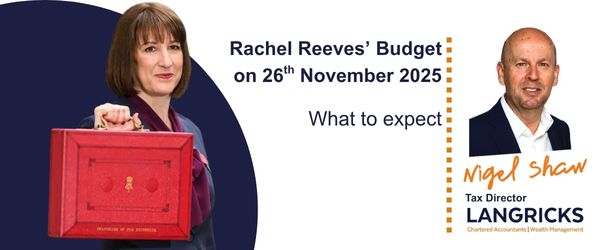
What to expect in Rachel Reeves’ Budget on 26 November 2025
Langricks’ Tax Director, Nigel Shaw, once again peers into his crystal ball to offer insight on what to expect in the upcoming Budget Statement later this month.
His task has been made easier by the Chancellor’s recent “scene-setting” speech, in which she warned of tough decisions ahead—i.e., further tax increases are imminent, likely including changes to one of the “big beasts” of the UK tax world.
So here goes on Nigel’s top 5 predictions:
1.Income Tax rates to increase by 2p
After an initial “funding gap/black hole” of £22bn in October 2024, it looks like the Chancellor is coming back for more of your money. Current projections estimate a new funding gap of up to £30bn, and at this level, she may have little choice but to increase all current Income Tax rates by 2p—to 22% (basic), 42% (higher), and 47% (additional).
By raising Income Tax rates by 2p, the additional revenue would do the “heavy lifting” for the predicted shortfall, generating roughly £16bn.
This 2p increase would be the first change in the basic rate since April 2008 when her friend and mentor, Gordon Brown, reduced the basic rate by the same amount. A sort of irony here, one “iron clad” Chancellor going one way and the other in the opposite direction, but then again Brown’s reduction was in anticipation of a general election 2 years later.
Also, expect a slight delay in the implementation of these new rates until 6 April 2026. This is a classic HM Treasury tactic to encourage taxpayers to “bring forward” bonuses, dividends, and other income before the increases take effect—a nice little bonus for the Tax Collectors.
2.Time for a Capital Gains Tax (CGT) exit charge on UK taxpayers leaving the country
The UK is an outlier when it comes to mobile business owners and entrepreneurs who build successful companies here and generate substantial capital gains. Consider, for example, Nik Storonsky of Revolut, who recently relocated to the UAE — an estimated £2 billion in CGT is thought to have been lost as a result.
The current government shows little support for wealth-creating individuals, so it is likely to seek ways to “plug” this CGT gap when you move to a country with no equivalent tax. Their justification will be that the capital gain was generated in the UK — and therefore they want their share of it.
3.Reduce 100% Capital Gains Tax (CGT) exemption on main home
If there is one group of asset owners in the UK which the Government believes are not paying their fair share it is UK homeowners (despite the UK suffering the highest level of property taxes across OECD countries)
UK property represents a major source of personal wealth, and we expect them to look to existing wealth taxes – including Capital Gains Tax (CGT), Inheritance Tax and Stamp Duty to generating additional funds to make up the spending gap.
Currently, your main residence is exempt from CGT when sold, allowing you to retain the full proceeds. Some might argue this exemption is necessary, given the high Stamp Duty payable when reinvesting in another property.
However, several left-leaning think tanks — including those with influence over the Chancellor — argue that regional disparities in house prices mean this exemption (costing the Treasury an estimated £30 billion annually) disproportionately benefits homeowners in London and the South East, which they view as unfair.
So, expect a “ceiling” to be placed on either the maximum sale proceeds that can benefit from the full exemption or a cap on the amount of gain which will be exempt when you come to sell your main home – possibly time related depending on how long you have lived there.
This CGT change might be part of a much bigger property tax re-structure also involving Council Tax.
4.Extend the freeze on Income Tax bands beyond 2029/30
This will be part of the “double whammy” in this year’s Budget.
Chancellors of all political stripes are addicted to something called “fiscal drag”—because it lets them increase taxpayers’ contributions without having to announce it in bright neon lights. Just a small note in the next Finance Bill, and hey presto: billions more generated over the course of the Parliament.
Expect the current tax allowance (£12,570) and tax bands—£37,700 (basic), up to £125,140 (higher rate), and above £125,140 (additional rate)—to remain unchanged until the end of the 2029/30 tax year, and probably well beyond.
In fact, the previous Government’s “fiscal drag” policy was so severe that millions of pensioners now have to pay tax on one of the lowest State Pension entitlements in the Western world.
5.Inheritance Tax (IHT) Lifetime Gifting is going to get more difficult
I’m not convinced that the Labour Government has finished tinkering with IHT, especially after the significant changes to pensions, business, and agricultural reliefs announced in October 2024.
The simplest and most effective IHT planning strategy remains gifting wealth to the next generation during your lifetime and then starting the 7-year survivorship clock, allowing your potential IHT bill to reduce to zero—hopefully.
Unsurprisingly, many left-leaning think tanks view this as immoral—passing wealth to your family? – and far too easy a way to avoid IHT on your estate. (Surely simplicity makes tax easier to understand?) Given this, I expect the government may introduce a lifetime cap on gifts, which would then be disregarded for future IHT calculations.
How much might this cap be? Probably around £325,000—aligned with the main IHT exemption, the “nil rate band.” It’s not a huge sum after a lifetime of generating wealth for yourself and your family, but the Labour Government doesn’t seem concerned.
Wealth creation appears to be a dirty word for them, so we can expect further inroads into everyone’s wealth through additional changes to the taxes mentioned above.
If you would like further information or advice on how the 2025 Budget may affect you or your business, please join us at one of our upcoming Breakfast Budget Seminars.
Holmfirth Seminar
???? Venue: Woodsome Hall Golf Club
???? Date: Tuesday 2nd December 2025
⏰ Time: 8:30am – 10:00am
(Bacon butties, tea & coffee provided)
>> Click here to Register for Holmfirth Seminar
Wilmslow Seminar
???? Venue: Langricks Chartered Accountants, 1 Swan Street, Wilmslow
???? Date: Wednesday 3rd December 2025
⏰ Time: 8:30am – 10:00am
(Bacon butties, tea & coffee provided)
>> Click here to Register for Wilmslow Seminar
What to Expect
Gain valuable perspectives from industry experts as they:
-
Unpack the key announcements from the Autumn Budget 2025
-
Highlight tax planning opportunities for individuals and businesses
-
Discuss practical next steps to help your business adapt and thrive
You’ll also have the chance to network with local business leaders in a relaxed and friendly setting.
Special Guest Speakers


Nigel Shaw – Tax Director, Langricks Chartered Accountants
Andrew Lloyd-Owen – Independent Financial Planner, Pareto
Reserve Your Place
Spaces are limited — register today to secure your spot at one of our informative and engaging sessions.
>>Click here to Register for Holmfirth Seminar
>>Click here to Register for Wilmslow Seminar

